Links marked See on Amazon are affiliate links: buy through one and we earn a commission at no cost to you. As an Amazon Associate I earn from qualifying purchases. Links to other retailers earn us nothing. How that works, and how the picks are made.
Most soapmakers end up with two scales, and the reason is arithmetic. A kitchen scale that reads in whole grams is fine for the oils and the lye in a batch of a pound or more. It isn’t fine for the fragrance, the colorant or the sodium lactate, which in a one-pound batch weigh between 1.5 g and 13.6 g. NIST recommends weighing nothing smaller than 20 of a scale’s display steps, which is 20 g on a 1 g scale, and 6 of the 9 separate weighings in a one-pound batch fall below it. So the choice is a pair: a kitchen scale for the batch and a finer one for the small weights, sized by the smallest thing you weigh and the pot you weigh into.
We haven’t tested these five ourselves. This site builds calculators, and this page reads the makers’ manuals and spec sheets against NIST’s weighing standards and against what soapmakers report on the Soapmaking Forum, where most of the evidence about auto-off, batteries and spills comes from. Every spec on a card comes from the maker’s page, manual or spec sheet, or a named retailer’s listing, read in Oct 2026; open “Where these specs come from” on any card for the wording and the links. Only one of the five makers publishes an accuracy figure, so the other cards say “Not published” rather than repeat a retailer’s claim.
The picks at a glance
| Pick | Capacity × step | Auto-off | Power | Price seen |
|---|---|---|---|---|
| My Weigh KD-8000Our default pick | 8,000 g × 1 g | About 2 or 5 min, or off | 3 AA, or the 5 V adapter | $55.30 |
| Escali Primo (P115)Budget whole-batch scale | 5,000 g × 1 g | Fixed 4 min | 2 AA (included) | $29.95 |
| American Weigh Scales SC-2KG0.1 g for lye and fragrance | 2,000 g × 0.1 g | Not published | 2 AAA (included) | $25.99 |
| American Weigh Scales SC-5010.01 g for colorants and test batches | 500 g × 0.01 g | Not published | 2 AAA (included) | $12.90 |
| Ohaus Scout SPX2201One scale for everything | 2,200 g × 0.1 g | Off from the factory; 1, 5 or 10 min | Mains adapter (included) or 4 AA | $492.50 |
Prices are one figure each from a named retailer, never Amazon, seen in Oct 2026; they move. Each card lists and links its sources.
My Weigh KD-8000
Weighing whole batches: oils into the pot, the lye solution, the batter. The auto-off can be switched off, which is the feature soapers buy it for.
- Price seen
- $55.30 at Scales Plus, Oct 2026
- Capacity × step
- 8,000 g × 1 g
- Published accuracy
- Not published
- Auto-off
- About 2 or 5 min, or off
- Power
- 3 AA, or the 5 V adapter
- Platform
- 7 × 7 in removable stainless tray
- Warranty
- 90 days; excludes commercial use
- Auto-off can be turned off ("OFF 0" in the manual). Soapers single this out; one called auto-off "that horrible bane of many a soap-maker".
- Runs on its mains adapter, which the maker lists as included, so a fading battery can’t drift a reading halfway through a batch.
- The most capacity here, 8,000 g, which leaves room for a heavy pot on every batch in the capacity table.
- A removable cover over the display, and a hold button for a pot too wide to read around.
- A 1 g step. Anything under 20 g (fragrance in a small batch, colorants, sodium lactate) wants a finer scale.
- Two owners report it doesn’t register the first 2–3 g of a slow pour; one puts a 10 g weight on first to get past it.
- The maker’s warranty is now 90 days and excludes commercial use. Older retailer copy still promises 30 years.
- Switching auto-off off means pressing two buttons together at power-on, which several owners found fiddly.
Where these specs come from
HBI Tech (My Weigh) KD-8000 product page ("8.000 kg / 8000 g", "3 x AA Batteries or DC 5v 300mA Power Adapter", power adapter listed under Included Accessories, "Removable Protective LCD Cover", 7″ × 7″ stainless tray); KD-8000 manual ("8000g x 1g"; auto-off: "The display will show "OFF 0" (disabled) or "OFF 1" (automatic turn off after about 2 minutes) or "OFF 2" (automatic turn off after about 5 minutes)"; "Press and hold [HOLD] and the [⏻] key to power on"; "be sure the clear protective LCD cover is not touching the underside of the tray as this may cause inaccurate readings"); HBI warranty page ("lasts for 90 days", excludes "commercial use"); Scales Plus listing ($55.30); no accuracy figure published. Soapmaking Forum: IrishLass (2018), "that horrible bane of many a soap-maker"; AliOop and dibbles (2024) on the first 2–3 g; DeeAnna (2016) on the button combination
Escali Primo (P115)
A first scale for whole batches at the lowest price here for 5 kg, if you weigh briskly and keep spare batteries.
- Price seen
- $29.95 at Scheels, Oct 2026
- Capacity × step
- 5,000 g × 1 g
- Published accuracy
- Not published
- Auto-off
- Fixed 4 min
- Power
- 2 AA (included)
- Platform
- The whole 8.5 × 6 in top
- Warranty
- Lifetime limited (maker policy); retailers disagree
- Sealed buttons and display, which matters when lye solution and fragrance oil are poured over it.
- 5,000 g covers the oils for a standard loaf in an ordinary pot.
- About half the price of the KD-8000.
- Turns itself off after four minutes of inactivity, and the maker publishes no way to stop it. Pause to open a new bottle of oil and you can lose the tare.
- Batteries only. A fading battery is a known cause of drifting readings (see below).
- A flat scale: a wide pot overhanging the front can hide the display.
- The maker’s own store showed every color sold out on the day we checked.
Where these specs come from
Escali Primo spec sheet "PRIMO-0714" (© 2014 Escali), Home Depot-hosted ("Capacity: 11 lb. (5000 g.)", "Weighing increments: 0.1 oz. (1 g.)", "Automatic 4 minute shut-off feature ensures long battery life", "Sealed buttons and display for protection against accidental spills", "Batteries included: 2-AA", "Dimensions: 8.5" x 6" x 1.5""); KitchenSupply product page ("The scale will turn off after four minutes of inactivity"; every color sold out); KitchenSupply warranty page ("Lifetime Limited Warranty or 2-Year Professional Guarantee on most of our products"); Scheels listing for P115M ($29.95); no accuracy figure published
American Weigh Scales SC-2KG
The second scale: lye, fragrance and additives in 0.1 g steps, with the capacity for a cup of lye or a jug of fragrance.
- Price seen
- $25.99 at American Weigh Scales, Oct 2026
- Capacity × step
- 2,000 g × 0.1 g
- Published accuracy
- Not published
- Auto-off
- Not published
- Power
- 2 AAA (included)
- Platform
- 4 × 4 in stainless
- Warranty
- 10 years in the manual; a 1-year badge on the listing
- 0.1 g steps up to 2,000 g. The recommended minimum load is 2 g, which brings fragrance, essential oils and sodium lactate for a small batch into range.
- The least expensive 0.1 g pick here by a wide margin.
- Two lids that double as weighing trays.
- A 4-inch platform. A pitcher or bowl hangs over the edges, and off-center loads are where scales err most; weigh into a small, light container.
- The maker publishes no auto-off time and no accuracy figure.
- AAA batteries; the version with a mains adapter is a separate model (SC2kgA).
- The maker’s own page disagrees with itself on the warranty: 10 years in the manual, 1 year on a badge.
Where these specs come from
American Weigh Scales SC-2KG product page ("2000g x 0.1g", "2 x AAA Batteries (included)", "Back-lit LCD Display", "10 Year Manufactures Warranty" and a "1-Year Warranty" badge, $25.99, MSRP $34.99); SC-Series manual ("2000g / 70.55oz", "0.1g / 0.01oz", platform "4.0 x 4.0 " Stainless Steel", "The removable covers can also be used as weighing trays", "10 Year Warranty"); no auto-off time or accuracy published; adapter model SC2kgA listed separately
American Weigh Scales SC-501
Colorants, essential-oil blends under a gram, and the lye for a very small test batch.
- Price seen
- $12.90 at American Weigh Scales, Oct 2026
- Capacity × step
- 500 g × 0.01 g
- Published accuracy
- Not published
- Auto-off
- Not published
- Power
- 2 AAA (included)
- Platform
- 4 × 4 in stainless
- Warranty
- 10 years in the manual; a 1-year badge on the listing
- 0.01 g steps: the recommended minimum load is 0.2 g, below the smallest weight in the table below.
- 500 g is enough for the lye, or the water, of a one-pound test batch in a light cup.
- The cheapest scale here.
- Checking a 0.01 g scale properly takes a class F2 test weight; coins can’t do it (see below).
- Recalibrating needs weights it doesn’t come with, and the maker’s page and manual disagree on which.
- No published auto-off time or accuracy, and it’s rated for 10–30 °C (50–86 °F), so not for a cold garage.
Where these specs come from
American Weigh Scales SC-501 product page ("500g x 0.01g", "2 x AAA Batteries (included)", "50°F to 86°F (10°C to 30°C)", calibration "500g weight (not included)", $12.90, MSRP $42.99); SC-Series manual ("500g / 17.64oz", "0.01g /0.001oz", platform "4.0 x 4.0 " Stainless Steel", "SC-501 uses a 100g and 2x 200g calibration weight", "10 Year Warranty"); no auto-off time or accuracy published; no ASIN read for this model
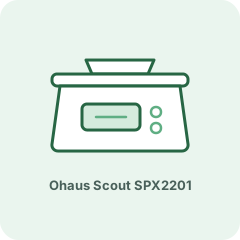
Ohaus Scout SPX2201
One instrument for a maker who works in small batches at 0.1 g throughout and wants a published accuracy figure behind the display.
- Price seen
- $492.50 at Labfilterz, Oct 2026
- Capacity × step
- 2,200 g × 0.1 g
- Published accuracy
- Repeatability 0.1 g, linearity 0.1 g
- Auto-off
- Off from the factory; 1, 5 or 10 min
- Power
- Mains adapter (included) or 4 AA
- Platform
- 6.7 × 5.5 in stainless
- Warranty
- Not in the manual; dealers say 1 or 2 years
- The only pick here with a published accuracy: repeatability and linearity of 0.1 g, one display step.
- Auto-off ships switched off, and it runs on the included mains adapter.
- A 1-second stabilization time and a display-hold mode.
- At 2,200 g it runs out early: a three-pound batch’s oils leave little room for a pot (see the capacity table).
- Not legal for trade: the spec sheet lists no NTEP certificate.
- The warranty length isn’t in the manual, and dealers disagree (one year or two).
Where these specs come from
Ohaus SPX2201 spec sheet (doc 80774942_E, 2018) and Scout SPX instruction manual, Ohaus PDFs hosted by Labfilterz because ohaus.com served an expired certificate on the day we checked (capacity 2200 g, readability 0.1 g, "Repeatability (Std. Dev.) 0.1 g", "Linearity 0.1 g", stabilization time 1 s, "AC adapter (included) or 4 AA batteries (not included)", "Auto off [A.OFF] … OFF = disabled 1 = powers off after 1 minute … 5 … 10", off shown in bold, "Bold always represents factory default value", "Display Hold" mode, pan 6.7 × 5.5 in, no NTEP approval listed); Labfilterz listing ($492.50, list $788.00; 2-year warranty per the dealer)
If you already own a kitchen scale that reads in grams and doesn’t switch itself off mid-pour, keep it. The second scale is the one to buy. The KD-8000 and the SC-2KG together cost $81.29, against $492.50 for the Ohaus, which earns its price only if you want one instrument with a published accuracy behind it.
Do I need a 0.1 g scale for soap making?
For the oils and the lye in a batch of a pound or more, no. For nearly everything else, yes. Here is every separate weighing in a one-pound batch of the classic bar, and what one display step does to each:
| Weighing | Grams | 1 g scale | 0.1 g scale | 0.01 g scale |
|---|---|---|---|---|
| Water (33% lye solution) | 132.4 | ±0.8% | ±0.1% | <0.1% |
| Sodium hydroxide (5% superfat) | 65.2 | ±1.5% | ±0.2% | <0.1% |
| Fragrance oil at 3% of oils | 13.6 | ±7.3% | ±0.7% | ±0.1% |
| Clove bud oil at its IFRA limit (1.7% of the soap) | 11.3 | ±8.9% | ±0.9% | ±0.1% |
| Essential oil blend at 2% of oils | 9.07 | ±11% | ±1.1% | ±0.1% |
| Sodium lactate, 1 tsp per lb of oils | 6.56 | ±15% | ±1.5% | ±0.2% |
| Mica, ½ tsp per lb | 1.50 | ±67% | ±6.7% | ±0.7% |
| Titanium dioxide, ½ tsp per lb | 1.48 | ±68% | ±6.8% | ±0.7% |
One pound (454 g) of oils of the classic bar (olive 35, coconut 30, palm 30, castor 5) at 5% superfat and a 33% lye solution; the small additions at the rates their own calculators use. The error is one display step, what NIST Handbook 44 lets a Class III trade scale be off by in service at loads this size; even a perfect scale rounds by half a step. Amber: under the recommended minimum load of 20 steps, which is the same line as 5%.
The lye is where the step matters most for safety, and at one pound a gram of lye is about 1.5 points of superfat; the first-batch guide works that through batch size by batch size. The small additions are where a 1 g scale fails outright: 13.6 g of fragrance oil is ±7.3% on a 1 g scale and ±0.7% on a 0.1 g one. Triple the batch and the fragrance clears the line at 40.8 g, but the titanium dioxide, at 4.4 g, still doesn’t. A long-time forum regular’s rule of thumb lands in the same place: whole grams are “sufficiently accurate” for batches of “at least 16 oz or 500 grams of fats”, and essential-oil blends under a gram need “0.1 to 0.01 gram accuracy”.
Clove bud oil’s IFRA category 9 limit on two supplier certificates is 1.7% of the finished soap: 11.3 g in a one-pound batch. A 1 g scale can be a gram out either way, so clove weighed exactly to the limit can put the bar 8.9% over it. On a 0.1 g scale the margin is 0.9%. Weigh an oil with a low limit on the fine scale, and aim one step under the limit rather than at it. The fragrance calculator turns the limit on your oil’s certificate into grams.
How much capacity do I need?
Capacity is the pot plus what goes in it, and the pot is often the heavier half. Tare zeroes the display, not the load cell: a 2 kg pot on a 5 kg scale leaves 3 kg for oils whatever the display says. Here is the room each capacity leaves for your container while you weigh the oils:
| Batch | Oils | Room left for the container on a scale of | ||||
|---|---|---|---|---|---|---|
| 500 g | 2,000 g | 2,200 g | 5,000 g | 8,000 g | ||
| Test batch1 lb of oils | 454 g | 46 g | 1,546 g | 1,746 g | 4,546 g | 7,546 g |
| Standard loaf10 × 3.5 × 2.5 in mold | 956 g | Won’t fit | 1,044 g | 1,244 g | 4,044 g | 7,044 g |
| Long loaf3 lb of oils | 1,361 g | Won’t fit | 639 g | 839 g | 3,639 g | 6,639 g |
| Slab5 lb of oils | 2,268 g | Won’t fit | Won’t fit | Won’t fit | 2,732 g | 5,732 g |
Room left is the capacity minus the oils. Weigh your empty pot once: if it’s heavier than the number in its column, that batch won’t fit. The standard loaf’s oils are sized by the mold volume calculator.
Capacity isn’t the only fit. Scales are tested with the load centered (Handbook 44’s shift test puts a third of capacity in each quarter of the platform), and a pot hanging over a small platform is outside what that test covers. The 0.1 g picks have platforms of 4 and 6.7 inches, so weigh lye and fragrance into a small, light container and keep the pot for the kitchen scale. Make sure nothing touches the pot either: a soaper on the forum traced readings that were badly off to the back of a pot resting against something. “It just has to lightly touch something to screw up the weight.”
Readability isn’t accuracy
The step on the display is the readability. Accuracy is how far the reading can be from the true weight, and most consumer scale makers don’t publish it: of the five here, only Ohaus does (repeatability 0.1 g, linearity 0.1 g, one display step). Where makers of finer instruments publish both, accuracy is usually coarser than the display. The Ohaus Scout STX2202 reads in 0.01 g steps with a linearity of ±0.03 g, and the Sartorius TE3102S reads in 0.01 g with ±0.02 g. Acaia, a coffee-scale maker, puts it plainly: “Display or readability is not the same as accuracy.”
The trade standard gives a yardstick. A Class III scale in service may be off by one step on loads up to 500 steps, two steps up to 2,000 and three up to 4,000 (NIST Handbook 44, Table 6). On a 1 g scale that’s ±1 g on a 4 oz bar, ±2 g on a kilogram of oils and ±3 g on three. Consumer scales don’t have to meet it, but it’s a fair measure of what a 1 g scale should do.
Most scales quietly re-zero small drifts. This automatic zero tracking is capped at half a step by Handbook 44 and works at up to half a step per second under OIML R76, and it also runs at zero after you tare. So a pour that starts from a zero reading and adds less than 0.5 g a second on a 1 g scale can leave the display at zero while weight goes on. American Weigh Scales says as much: “it is possible to continuously add small weight to the platform without the display ever changing from 0.0g.” Two KD-series owners on the forum describe the same thing as a scale that “doesn’t register a weight until about 3 grams of oil have been poured”. Start the pour briskly so the display leaves zero, put a small weight on the platform first (one owner uses a 10 g calibration weight), or weigh small amounts on the fine scale.
Auto-off, batteries and drift
Auto-off comes up more than any other complaint in soapmakers’ scale threads, because a scale that switches itself off mid-pour loses its tare, and with it the count of what’s already in the pot. One forum regular called the ability to turn it off a KD scale’s “biggest selling point”. Of the five picks, My Weigh KD-8000 and Ohaus Scout SPX2201 let you turn it off or ship with it off; the Escali Primo (P115) shuts off after four minutes with no published way to stop it; and American Weigh Scales publishes no figure for its SC-2KG and SC-501. A mains adapter helps but isn’t a guarantee: one KD-7000 owner reports it shut off “even with the plug adapter”. Weigh each container empty and write the weight on it, as Modern Soapmaking suggests; if the scale does go off, you can subtract the number instead of starting again.
Batteries drift before they die. One soapmaker’s scale read a nickel as “4g” not “5g”; another’s read 5 g “immediately” after new batteries. Trade rules require a scale to stay within tolerance or blank its display when the battery runs low; consumer scales aren’t held to that, and a Taylor manual just warns that readings may “grow dim or irregular”. Change batteries at the first sign, or run on the adapter. Let a scale brought in from the cold reach room temperature (Sartorius advises about two hours for its balances), and put it on something rigid: one soaper’s readings were “43-54% off” on a card table that sagged in the middle.
How do I check a digital scale?
Weigh something of known mass, in the range you use. Coins are the household option:
| Coin | Mass | Legal tolerance |
|---|---|---|
| Nickel | 5.00 g | ±0.194 g |
| Quarter | 5.67 g | None published |
| Dime | 2.268 g | None published |
| Penny (1983 or later) | 2.50 g | ±0.13 g |
Masses from the US Mint’s coin specifications; tolerances from 31 U.S.C. §5113, which sets them only for the nickel and the cent. Pennies dated 1982 or earlier may be the heavier copper cent, and the Mint struck its last circulating penny in November 2025.
Ten nickels should read 50 g, give or take 1.94 g if every coin sat at its legal limit (about 3.9%). That catches a scale that’s badly off, from a failing battery for instance, but it can’t confirm a 0.1 g scale to 0.1 g. Five quarters weigh 28.35 g, one ounce; four weigh 22.68 g. For a real check, use a test weight. Uline sells ASTM Class 5 weights, good enough for 1 g and 0.1 g scales, at $54 for 100 g (seen in Oct 2026). A test weight has to be within a third of the scale’s tolerance (Handbook 44, Appendix A), so a 0.01 g scale needs a finer class (OIML F2 or ASTM Class 4).
Protecting a scale from lye and fragrance oil
Fragrance and essential oils dissolve plastic, and lye strips paint and worse. Soapers report a cover that had “melted onto the plate from the FO”, an essential oil that “ate away at the plastic”, and a scale with “a hole burned on part of it” by lye. The protection is cheap: cling wrap over the scale, changed after weighing lye, or the whole scale in a gallon zip bag “with the opening pointed away from you”. A stainless platform and sealed buttons help; plastic display covers are the first thing to go.
If you sell soap: does the scale need to be legal for trade?
In the US it depends on how you sell.
- By weight at the table (priced per ounce, weighed in front of the customer): yes, in every state guidance we read. The scale needs a National Type Evaluation Program (NTEP) certificate, and usually inspection and registration. Washington’s guidance for market vendors: “Portion scales and scales displaying “not legal for trade” are not suitable for sales.”
- By the bar, with a net weight on the label: the bars have to make the weight. A lot must average at least the labeled weight, and no bar may be short by more than Handbook 133’s maximum allowable variation: 7.2 g for a 3 oz, 100 g or 4 oz bar, and 9.0 g for a 5 oz one (Table 2-5). An inspector checking a 4 oz bar uses a scale step no larger than 1.2 g (Chapter 2), so a 1 g scale is the coarsest that matches.
Whether the scale you pack with must itself be certified is a state question. Vermont says a back-room packaging scale doesn’t need NTEP approval; Oregon notes that commercial scales “are often used to certify package weights” and requires commercial scales to be licensed. Ask your state weights and measures office, and keep a kitchen scale off the sales table: the model law presumes a scale at a place of sale is used for sales. A certified scale costs more and often reads coarser in certified use: Ohaus’s Valor 4000 V41PWE6T weighs 6,000 g in 1 g steps but 2 g steps when certified, at $488.75 from Labfilterz in Oct 2026. It’s for checking packaged bars, not weighing colorant. The US labeling guide covers what the label itself must say, and the bar count calculator sizes a loaf to a labeled weight after cure.
In Great Britain it’s stricter and simpler. GOV.UK: “you cannot use domestic scales to weigh goods you intend to sell.” A scale used to make up or check packages must be verified, and the government guidance suggests it should resolve to a fifth of the tolerable negative error: for a 100 g bar, whose tolerable negative error is 4.5 g (Schedule 3), that’s 0.9 g, and no bar may weigh under 91 g. The UK and EU labeling guide covers the rest.